Home Sleep Test vs In-Lab Study: How to Choose
⚡ Key Clinical Takeaways
- A home sleep apnea test (HSAT) is a portable recording device you take home, wear overnight in your own bed, and return the next day.
- An in-lab sleep study — polysomnography — is a comprehensive recording performed overnight at a sleep center with a technologist present.
- The AASM patient guide summarizes the same trade: the in-center test is more accurate and can detect other sleep disorders, while the home test costs less and is more comfortable, with the…
- AASM criteria narrow the home option to a specific profile.
- Expect your provider to order an in-lab study when any of the following apply:
Quick answer: In the home sleep test vs in-lab sleep study decision, the home test is a portable recorder for your own bed — best for straightforward suspected obstructive sleep apnea — while the in-lab study is an attended, hospital-grade recording that also measures brain waves and can diagnose other sleep disorders. Your medical history and symptom severity decide which one you get, not personal preference alone.
Both tests are legitimate diagnostic tools, and both end with the same outcome: a physician reads breathing data and tells you whether you have a sleep disorder. The American Academy of Sleep Medicine (AASM) accepts either an in-center test or a home sleep apnea test for diagnosing obstructive sleep apnea (OSA) in adults — and states plainly that a diagnosis cannot rest on a questionnaire alone.
What differs is where the recording happens, what gets measured, who watches it, what it costs, and which conditions can disqualify the home option.
The stakes are worth the comparison: untreated obstructive sleep apnea is linked to high blood pressure, daytime sleepiness and accident risk, so the goal is to get diagnosed with the right test the first time. This guide compares the two formats side by side so you know what to ask for and why.
What is a home sleep test?
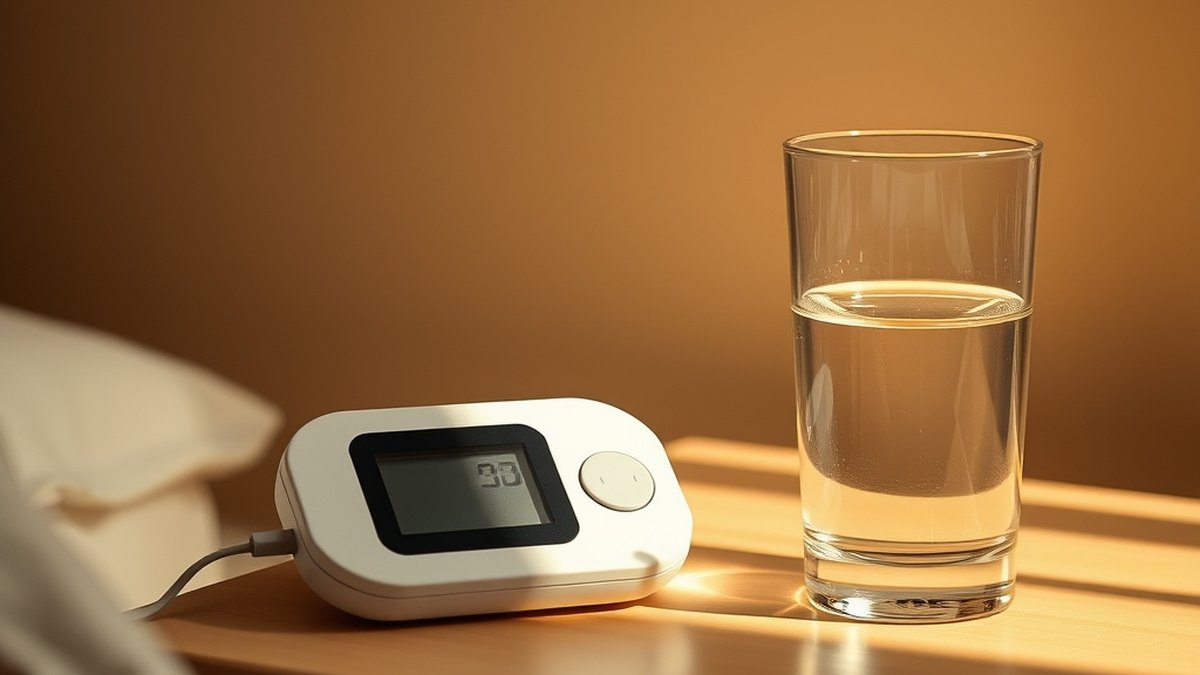
A home sleep apnea test (HSAT) is a portable recording device you take home, wear overnight in your own bed, and return the next day.
A typical kit includes a clip-on pulse oximeter for the finger, a chest belt that senses breathing effort, and a thin nasal tube that measures airflow. The device records around four breathing-related signals for one to three nights.
Because it does not record brain waves, it cannot tell sleep from quiet wakefulness, cannot stage your sleep, and cannot detect disorders that are not breathing-related.
It answers one question: is obstructive sleep apnea likely, and roughly how severe? For a deeper walkthrough of the at-home format, our guide to the home sleep study covers the equipment and nightly routine.
What is an in-lab sleep study?
An in-lab sleep study — polysomnography — is a comprehensive recording performed overnight at a sleep center with a technologist present.
Sensors on the scalp, face, eyelids, chest, limbs and finger record brain waves, eye movements, muscle tone, breathing, oxygen and heart rhythm. The National Heart, Lung, and Blood Institute (NHLBI) lists this as the most common form of sleep study, recording brain waves and monitoring heart rate, breathing and blood oxygen across a full night of sleep.
The extra signals are what let the test find more than apnea: sleep stages, subtle arousals, leg movements, and — with daytime testing — conditions such as narcolepsy.
Staffing is the other difference. If a sensor slips at 2 a.m., someone is there to fix it, which protects the quality of the recording in a way no home device can match. Our walkthrough of what to expect during a sleep study describes the attended night in detail.
Home sleep test vs in-lab sleep study: the comparison
| Point of comparison | Home sleep test | In-lab sleep study |
|---|---|---|
| Location | Your own bed | Sleep center bedroom |
| Attended by staff | No | Technologist present all night |
| Signals recorded | ~4 breathing-related signals | 12+ signals including brain waves |
| Sleep stages measured | No | Yes |
| Detects central apnea | Unreliably | Yes |
| Detects narcolepsy, leg movements | No | Yes (plus daytime MSLT) |
| Nights of recording | 1–3 | 1 |
| Cost | Lower | Higher (facility + staff) |
| Comfort | Higher — own bed, fewer wires | First-night effect possible |
The AASM patient guide summarizes the same trade: the in-center test is more accurate and can detect other sleep disorders, while the home test costs less and is more comfortable, with the caveat that it measures less and misreads more often when the equipment is fitted badly.
Neither format is better in the abstract. The lab is the sharper instrument; the home kit is the accessible one. A good sleep physician chooses the tool that answers your clinical question in one recording rather than two.
Who qualifies for a home sleep test?
AASM criteria narrow the home option to a specific profile. You are a candidate when your symptoms suggest a higher risk of moderate-to-severe OSA and you do not carry major complicating conditions.
- Risk profile: significant daytime sleepiness or tiredness, plus at least two of the following — routine loud snoring, witnessed gasping during sleep, choking or holding your breath while asleep, or high blood pressure.
- No complicating conditions: significant heart or lung disease, neuromuscular conditions, a history of stroke, chronic opioid use, or suspicion of other sleep disorders all steer the choice to the lab.
Mild OSA is diagnosed most accurately in the lab, so providers often send suspected mild cases there.
AASM position statements add two procedural rules: the home test must be ordered by a medical provider after an examination, and the raw data must be reviewed by a physician board-certified in sleep medicine. It is a medical assessment, not a consumer gadget.
When is the in-lab study the right choice?
Expect your provider to order an in-lab study when any of the following apply:
- You have significant cardiac, pulmonary or neuromuscular disease, a history of stroke, or chronic opioid use.
- Central sleep apnea or another sleep disorder (narcolepsy, REM sleep behavior, severe periodic leg movements) is suspected.
- Your symptoms suggest mild apnea, where home testing is least accurate.
- A previous home test was negative or unclear while symptoms persist.
- A titration study is needed to set pressure levels for PAP therapy.
NHS guidance mirrors this: most people suspected of sleep apnoea get a home device first, but sometimes an overnight clinic stay is needed.
One more lab-only scenario deserves a mention: pressure titration. When therapy is about to start and the right pressure setting is unknown, the attended study can run diagnosis and titration in one visit — a task a home kit is not designed for.
What does each test miss?
The home test's limits are structural, not a quality problem with any device. Estimating sleep time from breathing signals can understate severity — a person whose apnea is strongly position-dependent may record fewer events lying on one side for one night.
The test also cannot see arousals, sleep-stage fragmentation or non-breathing disorders. Sensor shift during the night can reduce data quality without any obvious sign to you.
In-lab studies have limits too: they are more expensive, the strange environment can delay sleep on the first night, and a single attended night is a snapshot of one evening. Neither test is a screening toy — both are ordered because symptoms justify them.
That is why a negative home test with ongoing symptoms usually leads to an in-lab study rather than a shrug. The AASM patient guide states that repeated testing should be done in the center.
Cost and insurance: how the two formats are covered
Cost favors the home test, because there is no facility fee or overnight staff. Exact prices vary by clinic and plan, so ask both for a written estimate.
Medicare's coverage rules document the difference precisely. Medicare Part B covers Type I, II, III and IV sleep tests for people with clinical signs and symptoms of sleep apnea, with 20 percent coinsurance after the Part B deductible — and Type I tests, the attended lab studies, are covered only when performed in a sleep lab facility.
If testing leads to therapy, Medicare may cover a 12-week trial of CPAP after an OSA diagnosis, then continue coverage with documented follow-up.
Private insurers follow similar logic: many require a home test first for uncomplicated cases and reserve the lab for complex ones. Prior authorization is common, and our guide to sleep study insurance coverage explains the paperwork.
How your doctor decides: the selection process
- Comprehensive sleep evaluation. Your provider takes a history and examines you — AASM standards require testing to happen with a complete sleep evaluation and follow-up, not as a stand-alone purchase.
- Symptom risk assessment. Sleepiness plus snoring, witnessed gasping, choking or hypertension point toward moderate-to-severe OSA — the home-test profile.
- Comorbidity screen. Heart or lung disease, neuromuscular illness, stroke history, opioid use or suspicion of other disorders moves the plan to the lab.
- Test ordered and scheduled. The provider orders the chosen test; you cannot self-refer for a diagnostic home kit.
- Result review. A sleep physician interprets the recording; a negative home result with persistent symptoms triggers the in-lab study.
The process exists to protect you from the wrong test: a home kit ordered without an evaluation can miss central apnea, and a lab study ordered for a straightforward case spends money and a night for no extra information.
If you need to arrange testing, compare nearby centers and ask each one how it decides between formats.
For example, the listings for sleep clinics in Dallas, TX or sleep clinics in Charlotte, NC include phone numbers, so a two-minute call can tell you whether a center runs both formats or refers one out — a detail that shapes how quickly your results come back.
Accuracy: which test is more accurate?
For uncomplicated adults with classic moderate-to-severe OSA symptoms, a technically adequate home test performs well, which is exactly why AASM allows it.
Accuracy falls outside that envelope: complex patients, suspected central apnea, and mild disease favor the attended study, where polysomnography remains the standard diagnostic test.
The practical framing for patients: accuracy is not a property of the test alone but of the match between the test and the patient. The right test for you is the one your provider selects after a full evaluation — and if that selection process seems missing, ask.
Frequently asked questions
Is a home sleep test as accurate as an in-lab study?
For uncomplicated adults with a high likelihood of moderate-to-severe obstructive sleep apnea, yes — that is the group AASM guidelines approve it for. It is less accurate for mild apnea and cannot detect other sleep disorders.
Can a home sleep test miss sleep apnea?
It can understate severity, especially if the sensors shift or your apnea is position-dependent. A negative home test with ongoing symptoms should be followed by an in-lab study.
Why would my doctor order an in-lab study instead of a home test?
Heart or lung disease, suspected central apnea or narcolepsy, suspected mild apnea, an unclear home test, or the need to adjust PAP pressure all call for the attended study.
How many nights does a home sleep test take?
The device records one to three nights depending on the clinic's protocol. Setup takes minutes, and you return the kit when the recording is done.
Can I buy a home sleep test myself?
No. AASM position statements classify the HSAT as a medical assessment that must be ordered by a licensed medical provider, with results interpreted by a board-certified sleep medicine physician.
Does insurance cover both test types?
Medicare Part B covers all four sleep test types with 20 percent coinsurance after the deductible, restricting Type I (attended) tests to sleep lab facilities. Private plans differ; ask for an estimate before scheduling.
Sources
- AASM — Diagnostic Testing for Obstructive Sleep Apnea in Adults: A Patient's Guide (home vs in-center criteria; advantages and disadvantages; repeat testing)
- AASM — Clinical use of a home sleep apnea test (position statement) (provider order; physician interpretation; not for general screening)
- AASM — Clinical Practice Guideline for Diagnostic Testing for Adult OSA (polysomnography as standard diagnostic test; HSAT for uncomplicated adults)
- Medicare.gov — Sleep studies coverage (Type I–IV; 20% coinsurance; Type I only in a sleep lab)
- Medicare.gov — CPAP therapy coverage (12-week trial after OSA diagnosis)
- NHS — Sleep apnoea (overnight home devices; clinic stay in some cases)
This article is general information and is not medical advice. Which test is right for you is a medical decision made by a qualified provider after a full sleep evaluation.
Ready to find an accredited sleep clinic near you?
Browse 7,246 verified sleep centers (4,975 AASM accredited), filter by tests and treatments, and reach out directly — all in one verified directory.
🔍 Search Accredited Centersor call a clinic directly from its profile — every listing has a verified phone number.
This medical guide complies with the American Academy of Sleep Medicine (AASM) standards of care for sleep disorders and reflects generally accepted clinical guidelines. It is informational and not a substitute for personalized medical advice.